


The Transparency4Safety Initiative has published a new Overriding Public Interest Report (OPIR) on undeclared SV40 sequences in Comirnaty’s manufacturing plasmid. The authors, Dr Silvia Behrendt, Dr David J. Speicher and Prof Dr Klaus Steger, reconstruct the events and critically assess the manufacturer’s submissions, the scientific basis of its safety claims, the rigour of regulatory oversight and the adequacy of the authorities’ response.
BioNTech/Pfizer’s initial marketing-authorisation dossier for Comirnaty failed to identify SV40 elements in the manufacturing plasmid used for large-scale commercial production, known as Process 2. Their nucleotide sequences had been supplied, but the SV40 elements were omitted from the accompanying plasmid annotation. BioNTech/Pfizer subsequently explained that it had considered these elements irrelevant to production. The report finds that this explanation supports an inference of deliberate omission.
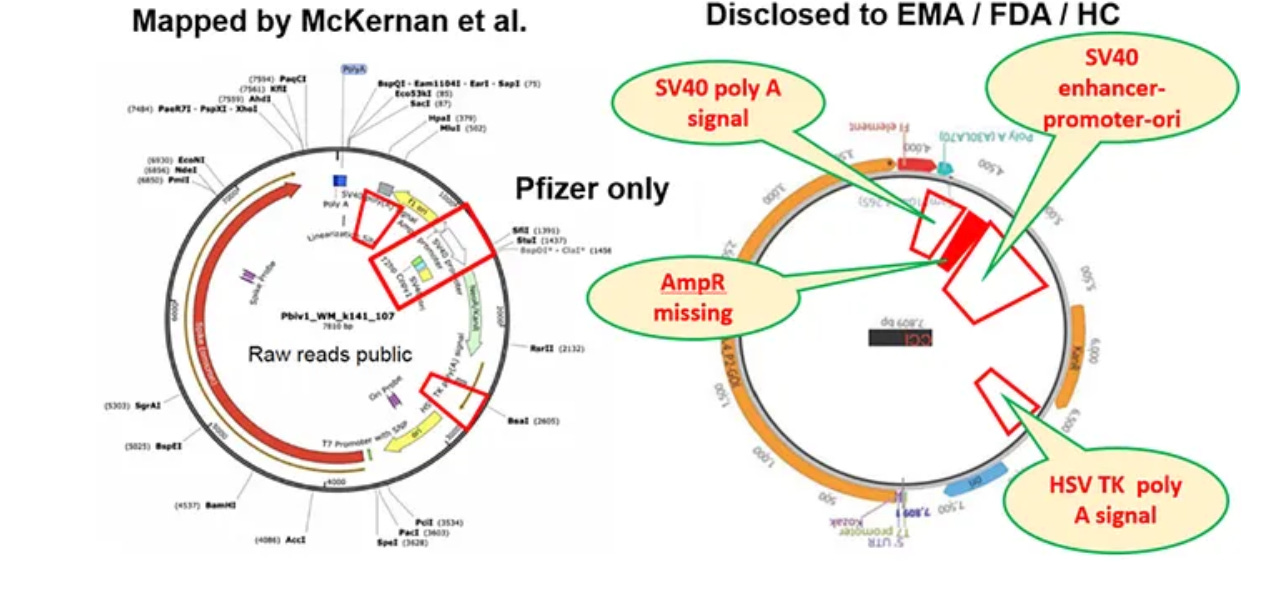
Original plasmid map submitted by BioNTech to EMA for market approval of Comirnaty,
EMA’s Rapporteur Rolling Report Quality, p. 24
Independent researcher Kevin McKernan brought the issue first to public attention through his analysis of vaccine vials in 2023. This was confirmed by Dr. David Speicher and other independent researchers, whose findings raise a direct question for EMA and the Paul-Ehrlich-Institut: why were there no controls of the plasmid, the sequences as well as the excessive thresholds of residual DNA in the finished drug product, despite the assurances that the product is “safe and effective” for human use?
The report reconstructs the available evidence in detail, tracing the plasmid’s development history, the manufacturer’s explanations and the regulatory decisions that followed. Health Canada’s own quality reviewers rejected BioNTech/Pfizer’s justification for retaining the SV40 elements and criticised the failure to disclose them from the outset.
BioNTech/Pfizer brought substantial gene-therapy expertise to the product’s development. The report examines why established knowledge concerning plasmid characterisation, gene delivery and genotoxicity was inadequately reflected in the safety assessment. Commission Directive 2009/120/EC excludes vaccines against infectious diseases from the legal definition of gene-therapy medicinal products. That exclusion predates Comirnaty. The OPIR argues that it cannot justify disregarding relevant scientific knowledge or displacing the obligations to protect human health and apply the precautionary principle.
The criticism concerns the evidence supporting the safety conclusions: incomplete characterisation of residual DNA, contested quantification methods and literature that, in the authors’ assessment, does not substantiate the claims made for this product. Particular attention is given to nuclear entry, persistence, genomic integration and potential insertional mutagenesis.
EMA and other regulators maintain that they have seen no evidence linking residual plasmid DNA to adverse effects. The report challenges whether the investigations and surveillance relied upon adequately address the proposed mechanisms and possible long-term consequences.
The disclosed correspondence shows regulators coordinating public assurances of safety while questions concerning residual DNA and the undeclared SV40 elements remained unresolved. EMA prepared common “lines to take” for national authorities while further characterisation was still outstanding. The OPIR alleges serious regulatory misconduct: authorities adopted and disseminated the manufacturer’s safety assurances without adequately resolving the evidential gaps on which those assurances depended. It identifies potential breaches of the duties of diligent and impartial examination, reasoned decision-making and precautionary protection of human health. These findings warrant an independent investigation into unlawful administrative conduct, responsibility for maintaining the authorisation and any resulting liability for harms to human health and for fraud by BioNTech/Pfizer.
More about SV40
https://geoffpain.substack.com/p/yin-yang-1-requires-endotoxin-to
Thank you for your work - I shared translated snippets from this for Finnish audience on X.